How to Choose a Digital Marketing Agency in 2026: A Practical Framework
To choose a digital marketing agency in 2026, start by defining a specific goal like leads, sales, or visibility then match the agency type to your business stage. Evaluate real case studies, not pitch decks. Confirm they understand AI-driven search (AEO/GEO), own transparent pricing including 18% GST, and will hand over your accounts and assets if you leave. In India, reliable retainers start around ₹15,000 to ₹1,00,000/month depending on scope. Avoid agencies promising guaranteed rankings or reporting only vanity metrics.
Hiring the wrong agency can cost you lakhs of rupees, months of lost momentum, and opportunities your competitors happily capture. Yet in 2026, choosing the right partner has become more difficult than ever. Every agency promises guaranteed rankings and explosive ROI, and after a few sales calls they all sound identical. What makes this year different is the ground itself shifting - AI is rewriting how people find businesses, search behaviour is evolving faster than most agencies can keep up with, and the old playbook is quietly losing its edge. This guide gives you a practical framework to evaluate any agency and choose the right digital marketing services partner for your business.
What a Digital Marketing Agency Actually Does in 2026
A digital marketing agency is a team that plans and runs your online marketing across digital channels - and, more importantly, ties that activity back to real business outcomes like leads, sales, and revenue. Whether the term you use is internet marketing, digital agency marketing, or just "running ads," the strongest agencies don't silo these activities; they connect strategy, execution, and measurement so you can see what your spend is returning.
Here are the core services most agencies offer today:
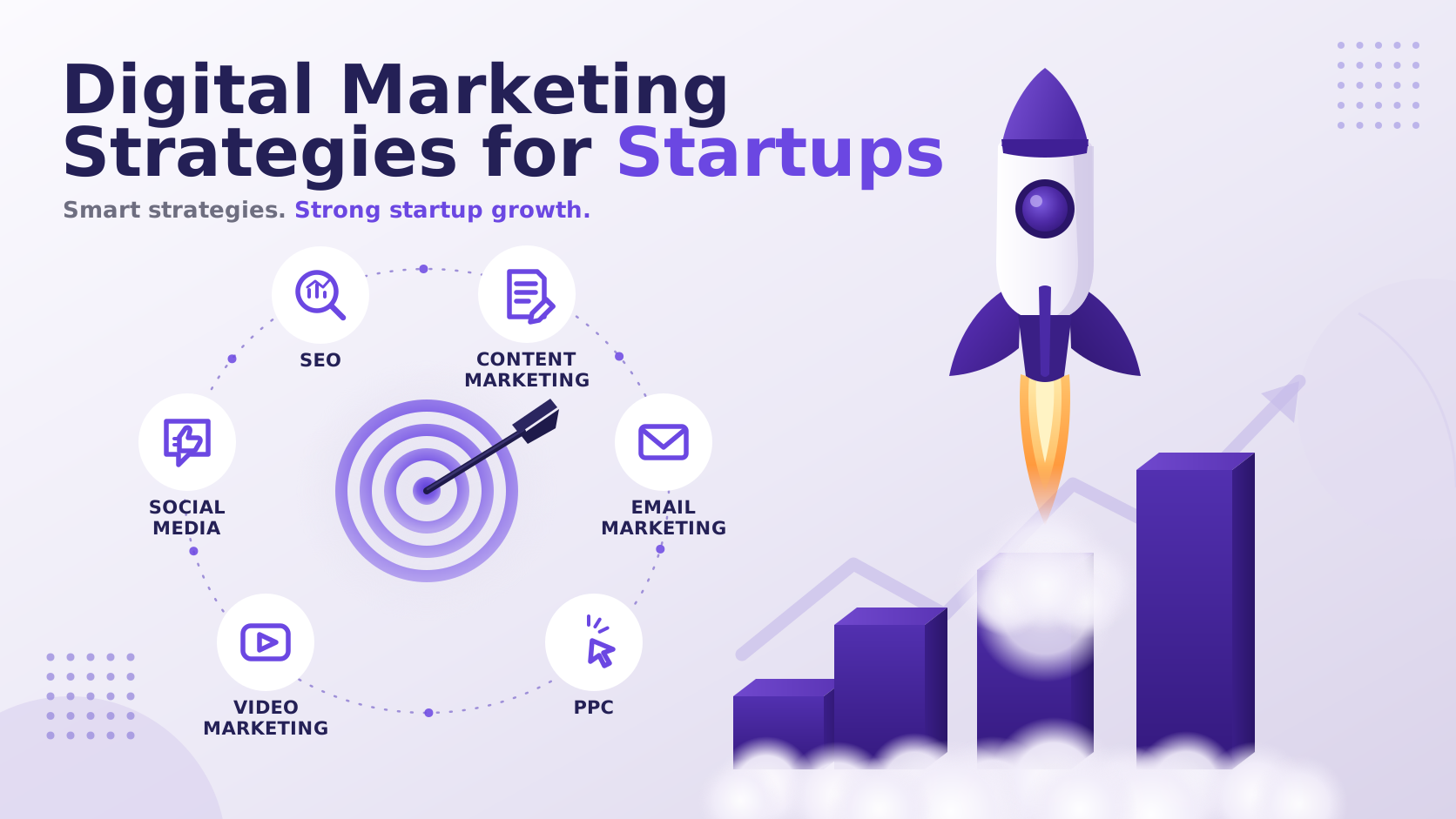
Search Engine Optimization (SEO) - improving your visibility in organic search, including technical health, content, and local search.
Paid ads / performance marketing - Google Ads, Meta, and other platforms, managed against measurable targets like cost per lead or return on ad spend.
Social media marketing - content, community management, and platform-specific strategy.
Content marketing - blogs, landing pages, and assets built around what your customers actually search for.
Web development - building and optimizing the site that all your campaigns send traffic to.
Email and CRM / marketing automation - nurturing leads and retaining customers with first-party data.
AI-led search optimization (AEO/GEO) - optimizing to appear inside AI-generated answers and AI Overviews, not just the traditional blue links.
It helps to know one distinction up front. A digital marketing and advertising agency usually leans heavily toward paid media - ad creative, campaign management, and media buying - and is a strong fit if growth through advertising is your priority. A full-service agency covers the wider mix above. Neither is "better"; the right one depends on what your business needs, which is exactly what the next section helps you figure out.
What's Different About Choosing an Agency in 2026
If you're evaluating agencies the way you would have a few years ago, you'll pick the wrong one. The signals that mattered then don't carry the same weight now. Here's what's changed:
Old way (pre-2024) | What matters now (2026) |
|---|---|
Ranking #1 in blue-link search results | Visibility inside AI Overviews and AI answers, since clicks are increasingly captured before users scroll. Independent studies in 2025 found organic click-through rates roughly halving on queries where Google shows an AI Overview. |
Heavy reliance on third-party cookie targeting | A first-party data strategy (your own email lists, CRM, site data), as third-party cookies become less reliable through user blocking and privacy controls - even though Google ultimately chose to keep them in Chrome. |
Pumping out content for volume | AI-assisted content with genuine human review for accuracy, originality, and brand voice. |
Reporting vanity metrics (followers, impressions) | Reporting tied to revenue and pipeline - leads, conversions, and ROI. |
The agency you want is one that can talk fluently about these shifts, not one still selling you 2021's playbook.
Freelancer, In-House, or Agency - Settle This First
Before shortlisting any digital marketing company, you need to answer a more fundamental question: is an agency even the right model for you right now? The three options serve very different situations.
A freelancer makes sense when your tasks are specific, one-off, and clearly defined - an SEO audit, a landing page, a campaign setup. Freelancers are usually narrow specialists who execute well but don't own strategy and rarely take initiative outside their brief. They work best when you already have an internal project manager who knows what to ask for.
In-house hiring works when your volume of work justifies a dedicated headcount and your marketing needs are consistent enough to keep a specialist fully occupied. The common mistake here is loading one person with everything - SEO, ads, content, design, email - when each of those is a full specialisation in itself. In-house also carries the risk of getting too close to internal processes and losing sight of what's working in the broader market.
A digital marketing agency or top marketing agency becomes the right call when you need multiple skills working together, want strategic accountability and not just execution, or lack the bandwidth to manage several freelancers at once. It's also the most flexible model - you're not locked into a salary if priorities shift. For most growing businesses in India, an agency sits at the right intersection of depth, breadth, and cost.
How to Choose a Digital Marketing Agency - A Step-by-Step Framework
Step 1 - Define Your Goals and Budget First
Before you Google "best digital marketing agency" and start taking calls, get clear on what success looks like for you. An agency can only be judged against a goal - and "more growth" isn't specific enough.
Get clear on:
The outcome you want - more qualified leads, higher online sales, better local visibility, or a stronger brand presence.
A rough budget range - even a ballpark helps agencies propose something realistic instead of a generic package.
Your timeline - whether you need a quick campaign or are building for the long term.
On budget, it helps to know the lay of the land. In India, lean or single-channel engagements often start around ₹15,000-₹40,000 per month, comprehensive retainers for a growing business commonly land in the ₹50,000-₹1,00,000 per month range, and larger or highly competitive accounts can run well beyond that. (We break this down properly in Step 5.) The point here isn't to fix a number - it's to walk into conversations knowing roughly where you sit.
Step 2 - Match the Agency Type to Your Business Stage and Function
One of the most common mistakes is hiring the wrong type of agency for where your business actually is. There are two ways to think about fit: by business stage, and by agency function.
By stage - use this as a starting map:
Your stage / need | Best-fit agency type | Why |
|---|---|---|
Early-stage startup, limited budget | Specialist or boutique team | You need focused execution on one or two channels, not a sprawling retainer you can't fully use. |
D2C brand scaling sales | Performance / digital marketing and advertising agency | Growth is driven by paid media and conversion tracking; you want a team obsessed with ROAS. |
Local service business | Local SEO specialist | Your customers search locally; you need Google Business Profile, local rankings, and review strategy. |
Established or enterprise brand | Full-service agency | Multiple channels working together - SEO, paid, content, automation - with dedicated account management. |
By function - among top digital marketing companies in India, four distinct types exist:
Agency type | What they focus on | Best for |
|---|---|---|
Creative agency | Brand identity, messaging, visuals, emotional storytelling | Brand-building, launches, mass-market products |
Performance / advertising agency | Paid ads, PPC, conversion optimisation, ROAS | Businesses where every rupee of ad spend must be tracked to a result |
Full-service digital agency marketing | Strategy + SEO + paid + content + web under one roof | Brands that need multiple channels working together without managing separate vendors |
Media agency | Ad placement, media buying across channels | Large enterprises with structured media budgets |
Most Indian SMBs and D2C brands get the most value from a performance agency or a full-service digital marketing company in India - the former if paid is your primary growth lever, the latter if you need the full stack. This isn't rigid, but it stops you from over-buying or under-buying.
Work With an Agency That Does it Right
Step 3 - Evaluate Their Track Record (Beyond the Pitch Deck)
Every agency's deck looks impressive. Your job is to separate real proof from decoration. Ask for case studies and references - ideally from businesses in your industry or with challenges similar to yours - and look closely at how specific their results are.
What real proof looks like:
Case studies with concrete before-and-after numbers (e.g., leads doubled in a defined period, cost per acquisition reduced by a measurable amount).
References you can actually contact.
Results in your industry or a comparable one.
Clarity on what they did versus what was already working.
What's just decoration:
Logos of big brands with no story attached to them.
Awards and badges with no link to client outcomes.
"Millions of impressions" with no mention of leads or revenue.
Vague claims like "we grew their business" without a single number.
If an agency can't show you outcomes, assume they don't have them.
Step 4 - Check Their AI and Search Visibility Capabilities
This is the step most businesses skip in 2026 - and it's increasingly the one that separates a forward-looking agency from one coasting on old habits. Search is no longer just ten blue links. Google now shows AI Overviews on a meaningful and growing share of queries, and multiple independent 2025 studies found that when an AI Overview appears, organic click-through rates fall sharply - in several analyses, roughly half or more of the clicks that used to reach websites no longer do.
What this means for you: ranking #1 isn't the finish line it once was. You need a partner who understands how to stay visible when an AI answer sits above your listing.
Ask whether they:
Have a strategy for Answer Engine Optimization / Generative Engine Optimization (AEO/GEO) - getting your brand cited inside AI answers and AI Overviews.
Understand how AI Overviews are affecting traffic in your specific niche, and can show you the data.
Use AI tools to work faster, but keep human review in the loop for accuracy, originality, and brand voice.
Track outcomes beyond rankings - actual qualified traffic and conversions.
An agency that gives you a blank stare here is optimizing for a version of search that's fading.
Step 5 - Understand Pricing, GST, and What "Cheap" Really Costs
Pricing in India is famously inconsistent - one agency quotes ₹15,000 a month, another quotes ₹2,00,000 for what looks like the same thing. The difference is almost always in scope, seniority, tools, and the size of the team on your account. Here's a realistic benchmark:
Engagement model | Typical range (India) | Best for |
|---|---|---|
Monthly retainer | ₹15,000-₹1,00,000+/month | Ongoing growth across SEO, social, and paid; the most common model. |
Project-based | ₹20,000-₹2,50,000+ | One-time needs like a website build, an SEO audit, or a campaign setup. |
Performance-based / hybrid | Base fee + a share of results | E-commerce and lead-gen, where outcomes can be tracked back to a sale. |
A few things to keep in mind. GST of 18% applies to digital marketing services in India, so budget for it on top of the quoted fee - and if you're GST-registered, you can typically claim input tax credit on it. When you run ads on platforms billed from outside India (like Google or Meta), GST can apply under the reverse charge mechanism, so clarify how that's handled.
Most importantly: don't choose on price alone. The cheapest option often skimps on strategy, tracking, and quality - and "cheap" campaigns with no real plan tend to cost more in the long run because they simply don't deliver. Focus on value: what you get back, not just what you pay.
Step 6 - Clarify Ownership, Contracts, and Reporting
This is the section nobody discusses until it goes wrong - and then it really goes wrong. Before you sign, get clarity on who owns what and how you'll work together:
Account ownership - make sure you own your Google Ads account, Meta Business account, website, domain, and analytics, not the agency. This is one of the most common painful surprises when a partnership ends.
Creative and content ownership - confirm you keep the rights to ad creatives, copy, and assets they produce for you.
Reporting cadence - agree on how often you'll get reports and what metrics they'll include (tied to business outcomes, not vanity numbers).
Point of contact - know who actually manages your account day to day.
Exit and handover terms - understand notice periods, what happens to your data and assets if you leave, and whether there's any lock-in.
A confident, transparent agency will have clear answers to all of this. Hesitation here is a warning sign.
Before You Commit - Consider a Trial Project First
Even after a thorough evaluation, you won't know how an agency actually works until money is on the table. If you're uncertain, propose a scoped trial before signing a long-term retainer. This could be a 30-day SEO audit and recommendations, a single paid campaign with a defined budget, or a content brief and first deliverable.
A trial serves two purposes: you see real work product from the actual team that will handle your account (not the senior strategist who pitched you), and you get a feel for their communication, turnaround time, and willingness to explain their thinking. Any best digital marketing agency worth hiring will agree to this without pressure. If they resist or insist on a minimum six-month lock-in before showing what they can do, that tells you something too.
Take these into your shortlisting calls. The answers tell you more than any proposal:
Can you share recent case studies with real, measurable results in my industry?
Who will actually work on my account, and who's my main point of contact?
How do you measure success - and which metrics do you report on?
What's your onboarding and discovery process before you start executing?
How do you use AI in your work, and who reviews the output for quality and accuracy?
What's your approach to AI Overviews and staying visible in AI-driven search?
Will I own my ad accounts, website, analytics, and creative assets?
What happens if we're not seeing results after three months?
Is your work done in-house or outsourced - and if outsourced, how do you ensure quality?
What are your contract terms, notice period, and any lock-in clauses?
Red Flags to Watch Out For
Some warning signs show up across almost every bad agency. Walk away if you see:
Guarantees that don't exist - "rank #1 on Google in 7 days" or "guaranteed #1 in AI Overviews." No one can promise these.
Focus on vanity metrics - followers and impressions with no link to leads or revenue.
One-size-fits-all packages - strategies that ignore your industry and audience.
No transparency - vague answers on pricing, timelines, or who's doing the work.
Heavy outsourcing with no accountability - work farmed out with no quality control or visibility.
No discovery process - they start executing before they understand your business.
100% AI-generated content with no human review - a fast track to generic, error-prone work that can hurt your brand.
Local vs Remote - Does Location Still Matter in India?
With so much work happening over video calls and shared dashboards, geography matters less than it used to - but it hasn't vanished entirely. The right answer depends on what you value.
A local agency makes sense when:
You want occasional face-to-face collaboration.
Your marketing depends on regional culture, festivals, or vernacular / regional-language SEO to connect with local audiences.
You're a local business needing hyperlocal expertise.
A remote agency makes sense when:
You want niche or specialized expertise that isn't available nearby.
You care more about performance and track record than proximity.
You're comfortable collaborating digitally and want faster turnaround.
In practice, strong digital marketing services in India are spread across metros and tier-2 cities alike, and many of the agencies operate as remote-first teams serving clients nationwide. When evaluating a digital marketing agency India-based or otherwise, let capability and fit lead - not proximity.
Final Checklist Before You Decide
Run your shortlisted agency through this quick scorecard. The more "yes" answers, the safer your choice:
Check | Yes / No |
|---|---|
I've defined a clear goal and rough budget | ☐ |
The agency type matches my business stage | ☐ |
They showed real, measurable case studies in or near my industry | ☐ |
They have a clear strategy for AI/AEO and modern search | ☐ |
Pricing, scope, and GST are transparent | ☐ |
I'll own my accounts, website, and creative assets | ☐ |
Reporting cadence and metrics are agreed in writing | ☐ |
No major red flags surfaced in our calls | ☐ |
Contract terms and exit clauses are clear | ☐ |
How Artha Social Can Help
Choosing the right partner comes down to the same things throughout this guide: clear goals, proof of real results, a modern approach to search and AI, transparent pricing, and an honest working relationship. At Artha Social, we bring all of that under one roof - SEO, performance marketing, web development, social media marketing, app development, and AI solutions - built around outcomes you can measure, not vanity numbers. If you're looking for the best digital marketing company in India that works as a true partner and not just a vendor, we'd love to talk.
If you're ready to work with a team that's transparent, accountable, and built for how marketing actually works in 2026, explore our digital marketing services and let's talk about your goals.
Newsletter
Get the SEO playbooks your competitors are searching for.
Weekly marketing techniques, proven strategies, and growth insights — no fluff.