Mistakes That Kill Your SEO in Digital Marketing (And How to Fix Each One)
A business owner shows us a website that looks perfectly fine. Clean design, blog posts going up every week, services listed neatly. Then they ask the only question that matters: why we are not getting any leads or any phone call? We see this same common SEO mistakes constantly across Tier-1, Tier-2 and Tier-3 Indian cities when businesses ask for our SEO services. The site is not broken by one big failure. It is bleeding leads through few small SEO mistakes, stacking up quietly until the traffic declines and nobody can point to why.
That is the trap. You keep publishing, keep paying for the occasional ad, and keep wondering why none of it turns into customers. The most common mistake is ignoring search intent, but it is only the start. This guide covers the SEO mistakes to avoid in digital marketing and the ways to fix each one. It is the same diagnostic we run in our own SEO services for clients, because the importance of SEO in digital marketing is simple. It brings you buyers already searching for what you sell, without paying for every click.
Key Takeaways
Ranking loss in SEO and digital marketing comes from small mistakes compounding, not one big error.
Ignoring search intent is the most common of the SEO mistakes to avoid in digital marketing.
Unedited, mass-produced AI content is demoted under Google's scaled content abuse policy.
Client-side JavaScript that ships an empty HTML shell hides your content from Google.
Core Web Vitals targets: LCP 2.5s or less, INP 200ms or less, CLS 0.1 or less.
Ranking first no longer guarantees visibility once an AI Overview answers first.
Track conversions and revenue, not rankings and total traffic alone.
Common Mistakes in SEO at a Glance
Table provided below covers biggest SEO mistakes in this guide in one view, with the quick fix for each. It is the fastest map of the common mistakes in SEO for digital marketing that break your rankings.
Mistake | Root Cause | Quick Fix |
|---|---|---|
Ignoring search intent | Built for the wrong query | Match content type to intent |
Keyword stuffing | Unnatural repetition | Write naturally, use synonyms |
Keyword cannibalization | Many pages, same keyword | Consolidate or re-target pages |
Thin content | Pages that add nothing new | Add depth and original insight |
Raw AI content | Unedited AI at scale | Edit, fact-check, add experience |
Weak E-E-A-T | No proof of experience | Add authors, sources, real detail |
Stagnant content | Old posts never updated | Refresh on a set cadence |
Blocked indexing | noindex or robots.txt errors | Fix in Search Console |
Client-side JavaScript | Empty HTML shell | Render on the server |
Slow Core Web Vitals | Heavy pages and images | Compress, cache, stabilise layout |
Broken links and 404s | Dead URLs, no redirects | Add 301 redirects |
Duplicate URLs | No canonical set | Add canonical tags |
Weak titles and meta | Duplicate or missing tags | Write unique, specific tags |
Weak internal linking | Orphan and deep pages | Link related pages together |
Poor mobile usability | Desktop-only design | Build mobile-first |
Toxic backlinks | Bought or spam links | Disavow, earn editorial links |
Neglected local SEO | Unmanaged Google profile | Fix NAP, categories, reviews |
Ignoring AI search | Optimised only for links | Structure for AI answers |
Vanity metrics | Tracking rankings only | Measure conversions and revenue |
Strategy & Keyword Mistakes That Undermine SEO in Digital Marketing
The most expensive mistakes in SEO in digital marketing happen before you write a word. They sit at the strategy layer, where one wrong call in your SEO plan wastes everything built on top.
Targeting Keywords Instead of Search Intent
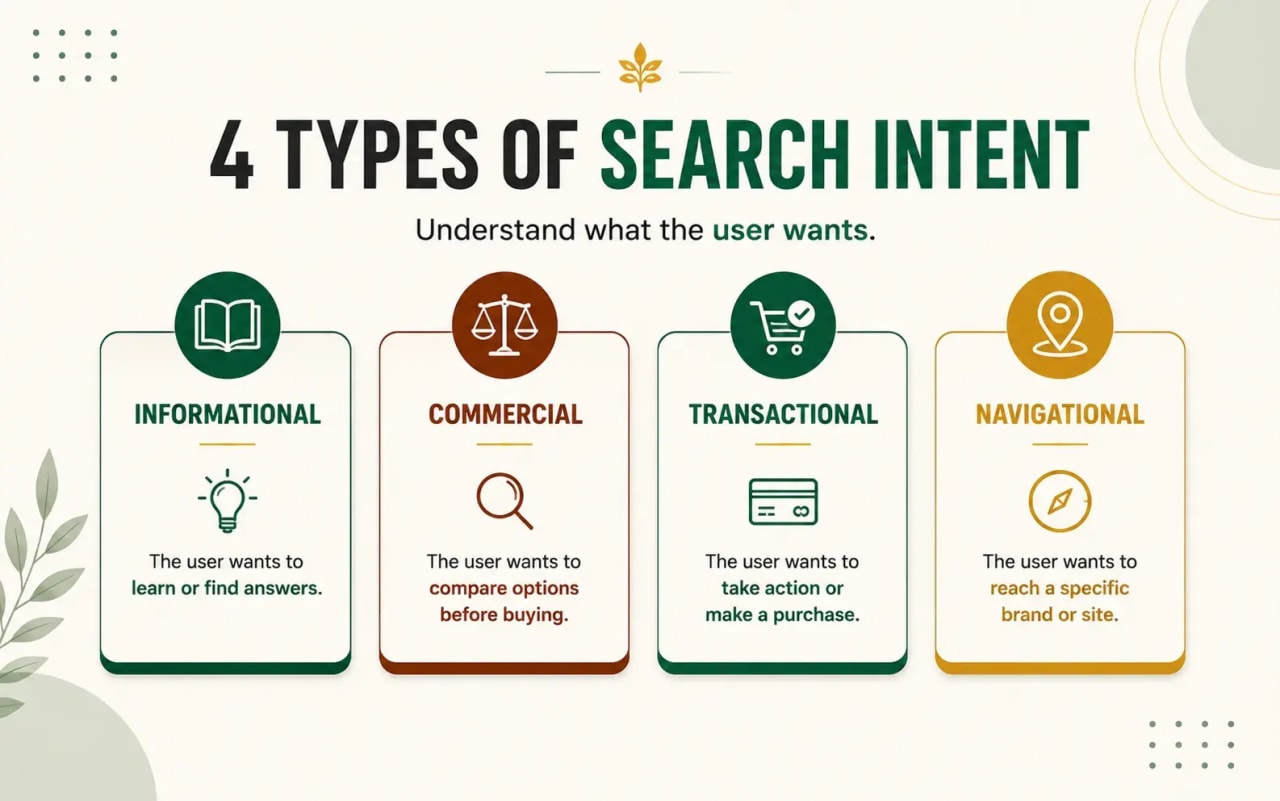
The mistake we see most in SEO for digital marketing is chasing a keyword while ignoring what the searcher wants. Rank a blog for a term that wanted a product page, and visitors bounce straight back to Google. Match the content type to the intent behind the query.
Search Intent | What the User Wants | Content Type That Fits | Example Query |
|---|---|---|---|
Informational | To learn something | Blog, guide, how-to | "what is seo in digital marketing" |
Commercial | To compare before buying | Comparison, review | "best seo agency in ranchi" |
Transactional | To act or buy | Service or product page | "hire an seo agency" |
Navigational | To reach a brand | Homepage, landing page | "artha social seo" |
Keyword Stuffing and Over-Optimization
The mistake: Cramming your keyword into every other line to force a ranking.
Why it hurts: Google reads unnatural density as manipulation and pushes the page down.
The fix: Write for the reader. Use the term where it fits, and synonyms everywhere else.
Keyword Cannibalization Across Pages
When several pages target the same keyword, they compete, and Google ranks none well. This splits authority across pages that should be one. Fix it by merging them into one strong page, redirecting the weaker URLs, or giving each a distinct term. This cleanup is core to real SEO and digital marketing.
Content Mistakes That Weaken SEO and Digital Marketing Results
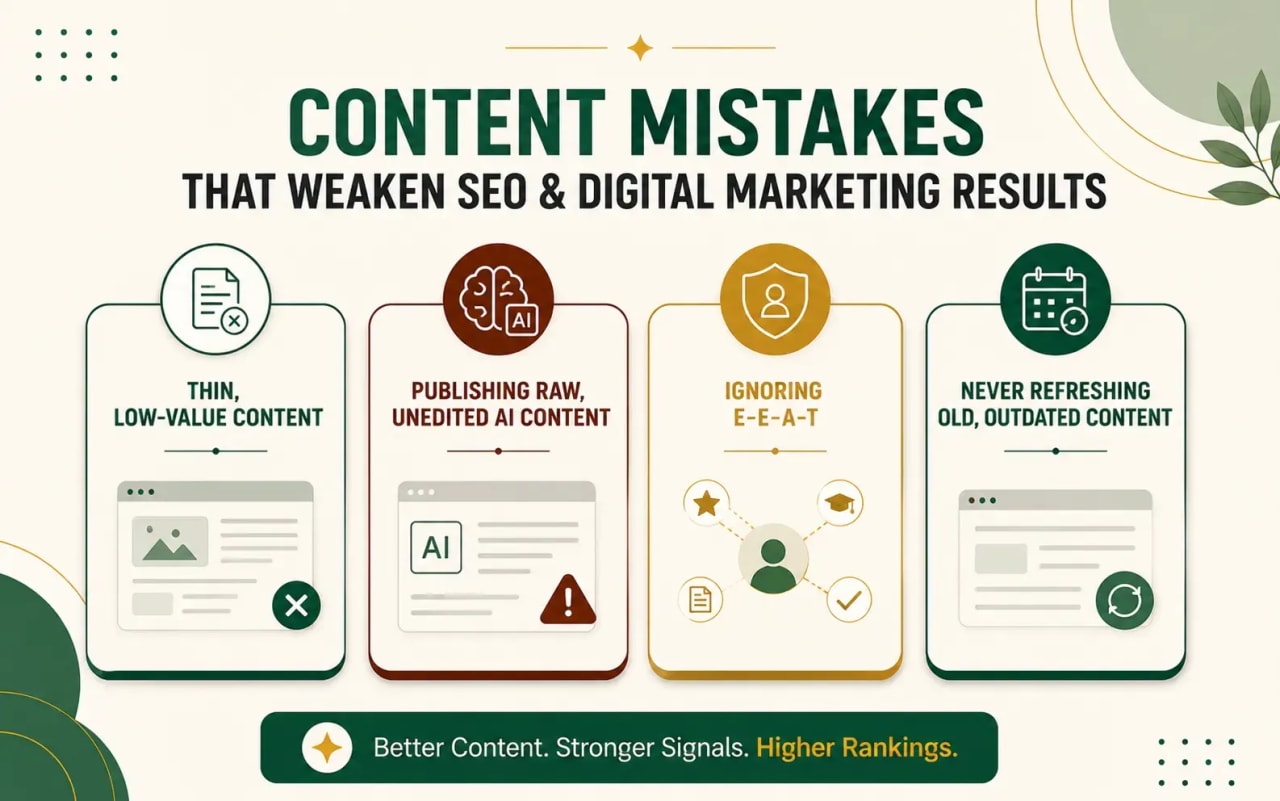
Thin or unedited content is the fastest way to trigger a quality demotion in SEO in digital marketing. Google has learned to spot pages that add nothing, and it buries them.
Thin, Low-Value Content
Thin pages are the most common own-goal in SEO and digital marketing. If your page repeats what ten others say, Google has no reason to rank it. Thin is not about length. It is about whether you add anything worth reading. Watch for these:
Pages that restate the obvious with no original point.
Near-duplicate service pages where only the city name changes.
Boilerplate copied across dozens of URLs.
Publishing Raw, Unedited AI Content
The mistake: Publishing AI drafts straight from the tool, at scale, with no editing.
Why it hurts: Google penalises for scaled content abuse: mass pages with no real value, whoever wrote them.
The fix: Draft with AI, then add your experience, check the facts, and cut the filler. In SEO for digital marketing, the human input is what ranks.
Ignoring E-E-A-T, Especially First-Hand Experience
Experience: Show you have actually done the thing. It is the signal most sites fake, and the one that matters most.
Expertise: Prove real knowledge through depth, not titles.
Authoritativeness: Earn mentions and links from others in your field.
Trust: Back claims with author bios and sources. Google's own guidance on helpful, people-first content puts this at the centre of what carries SEO in digital marketing over time.
Never Refreshing Old Posts
The mistake: Publishing a post once and never touching it again.
Why it hurts: Rankings erode as the content ages and fresher pages overtake you.
The fix: Set a refresh cadence, update the numbers, and republish.
Technical SEO Mistakes to Avoid
Technical faults do not announce themselves. The site still loads while rankings quietly decline, which makes these the most dangerous mistakes in SEO and digital marketing.
Pages Blocked From Indexing
The mistake: A stray noindex tag, a robots.txt Disallow, or crawl errors.
Why it hurts: A page that is not indexed cannot rank at all. It is invisible.
The fix: Open the Pages report in Google Search Console and clear the block. No index, no ranking.
Client-Side JavaScript Google Can't Render
This is the mistake almost nobody in SEO in digital marketing talks about, and it is everywhere now. Sites built as single-page apps in React or Vite often ship an almost empty HTML file. The content appears only after JavaScript runs, and as Google's own JavaScript SEO guide explains, it does not always render that JavaScript in time. The crawler finds an empty shell, and your content is invisible. We have audited sites that looked perfect to visitors but showed Google nothing.
Render on the server: Use SSR or static generation so the content sits in the HTML.
Test what Google sees: Use the URL Inspection tool, not just your browser. This one fix wins more ground in SEO in digital marketing than most content work.
Slow Core Web Vitals: LCP, INP, CLS
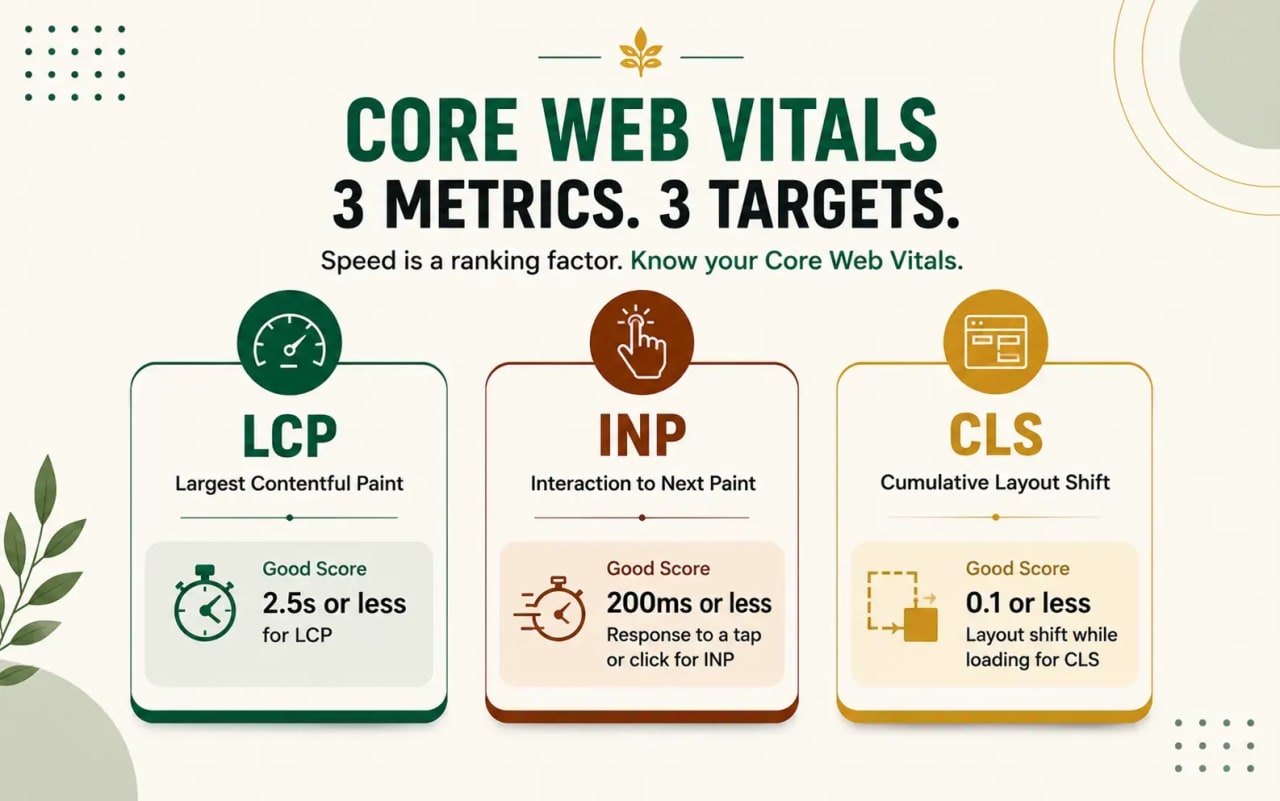
"Make your site faster" helps nobody. Speed is a ranking factor in SEO in digital marketing, measured through three Core Web Vitals. Know your targets.
Metric | What It Measures | Good Threshold | Common Cause |
|---|---|---|---|
LCP | Main content load time | 2.5s or less | Large images, slow server |
INP | Response to a tap or click | 200ms or less | Heavy JavaScript |
CLS | Layout shift while loading | 0.1 or less | Images with no set size |
Broken Links and 404s Without Redirects
The mistake: Dead internal links and old URLs returning 404 errors.
Why it hurts: They waste crawl budget, break the user path, and leak authority.
The fix: Map broken URLs and add 301 redirects. Clean paths are basic hygiene in SEO in digital marketing.
Duplicate Content and Missing Canonical Tags
The same page can live at several URLs without you noticing: http and https, www and non-www, and parameter URLs. Google splits the signals between them. A canonical tag tells Google which version is real. Set it on every page and stop competing against yourself.
On-Page & Structure Mistakes in SEO
On-page basics are cheap to fix and still mishandled on nearly every site we audit. They are the easiest wins in SEO to claim.
Weak Titles, Meta Descriptions, Headings & Image Alt Text
Title tags: Duplicate, missing, or cut off past 60 characters. Write one clear, specific title per page.
Meta descriptions: Blank or dull. This is free ad copy in the results, so use it.
Headings: More than one H1, or levels used for styling. Keep one H1 and nest the rest in order.
Image alt text: Missing or generic. Describe the image so it earns image search and stays accessible.
Weak Internal Linking and Orphan Pages
The mistake: Important pages buried deep, or orphaned with nothing linking to them.
Why it hurts: Internal links pass authority and help Google find pages. Weak linking strands your best content.
The fix: Link related pages together, and keep key pages a few clicks from the homepage.
Ignoring Mobile-First Usability
Google ranks the mobile version of your site, not the desktop one. If your mobile pages hide content or use tiny tap targets, that is what Google judges. Most Tier-2 and Tier-3 buyers are on mid-range phones, so build for that screen first and keep mobile content equal to desktop.
Off-Page & Local SEO Mistakes to Avoid
Bad links now do more damage than none, and a neglected local profile transfer customers to your competitor. These are common SEO mistakes to avoid in digital marketing, and both are fixable.
Chasing Low-Quality or Toxic Backlinks
The mistake: Buying bulk links, using private blog networks, or over-optimising anchor text.
Why it hurts: Google devalues these at best, penalises at worst. You paid to hurt yourself.
The fix: Disavow toxic links, then earn editorial links from real, relevant sites. Unlike SEO advertising, earned links keep working after you stop.
Neglecting Local SEO: GBP, NAP, Reviews & Local Schema
For a local business, your Google Business Profile often outranks your website, and local SEO in digital marketing turns visibility into walk-in customers. Here are the local SEO mistakes to avoid:
Local Element | Common Mistake | The Fix |
|---|---|---|
NAP | Name, address, phone mismatch | Standardise everywhere |
Primary category | Vague or wrong category | Pick the most specific one |
Reviews | Gating or ignoring them | Reply to all, never gate |
Local schema | Missing LocalBusiness markup | Add accurate local schema |
Most local SEO mistakes trace back to one of these four elements. Fix them in order, and your local visibility will climb faster.
The New SEO Mistake: Ignoring AI Search & AEO
Ranking first no longer guarantees a visit. If an AI Overview answers the query at the top, the searcher may never scroll to you. This is the newest mistake in SEO in digital marketing, and it is reshaping the field faster than any update before it.
Optimizing Only for Blue Links, Not AI Overviews
The job has grown. Classic ranking gets you a link. Answer Engine Optimization and Generative Engine Optimization get you cited inside the AI answer. Knowing the difference between search engine optimization and search engine marketing is one thing. The real 2026 gap is ignoring AI answers entirely.
Approach | Primary Focus | How You Win |
|---|---|---|
Traditional SEO | Ranking in the link list | Keywords, links, technical health |
AEO | Being the answer in AI Overviews | Clear, direct, structured answers |
GEO | Being cited by AI tools | Original data and authority |
Answer first: Put the direct answer in the first two or three sentences.
Clean structure: Use headings, short paragraphs, and schema.
No-JavaScript content: Keep the answer in the HTML. This is the next edge of search engine optimization and digital marketing.
Measurement & Maintenance Mistakes
If you only watch rankings and traffic, you measure the wrong things. They climb while the business stays flat, and the whole point of SEO in digital marketing is business results.
Treating SEO as a One-Time Project
SEO is not a setup you finish and forget. Google updates, competitors publish, and your pages lose ground the moment you stop. Businesses invest once, see a bump, then go quiet and wonder why it faded. The role of SEO in digital marketing is closer to fitness than surgery. Stop, and it fades.
Measuring Rankings Instead of Revenue
Good SEO and digital marketing is measured in revenue, not position. Track the KPIs that reach the bottom line:
Organic conversions: How many visitors became inquiries or customers.
Revenue and ROI: What the work returned, not how much traffic it drew.
Non-branded traffic: Visits from people who did not already know you.
AI-engine citations: New for 2026, and now a real KPI in SEO in digital marketing.
Let Artha Social Fix What's Actually Broken
You now know the top SEO mistakes to avoid. The harder part is spotting which of these top SEO mistakes your own site is making, and which is doing the most damage. That is the first question we answer for every client.
Artha Social is an SEO-first digital marketing agency, not a generalist shop that treats SEO as a checkbox. We start with a full audit across technical, on-page, content, off-page, Competitor analysis and local, because that is where honest SEO in digital marketing begins. Guessing wastes more budget than the mistakes do. If two or three problems here sound familiar, more are hiding underneath. Tell us what your site is doing, and we will show you what costs you rankings.
We Don't Do Marketing. We Build Momentum.
Frequently Asked Questions
What Are the Most Common SEO Mistakes Businesses Make?
The most common SEO mistakes are ignoring search intent, publishing thin or unedited content, and neglecting technical health like indexing and Core Web Vitals. For local businesses, the biggest SEO mistakes usually sit in an unmanaged Google Business Profile. Fix those first, then work down the list.
Is Duplicate Content Bad for SEO, and How Do I Fix It?
Yes. Duplicate content splits your ranking signals and leaves Google unsure which version to show. It rarely triggers a penalty, but it dilutes performance. Fix it with a canonical tag on the version you prefer, merge similar pages, and give each URL different content.
Does SEO Penalize AI-Generated Content?
No. Google does not penalise content for being AI-made. It penalises low-value, mass-produced pages, whoever wrote them. Draft with AI, then add your experience, check facts, and edit hard. In SEO in digital marketing, the human input earns the ranking.
Is SEO a One-Time Process or an Ongoing Effort?
It is ongoing. Algorithms change, competitors publish, and your content loses ground the moment you stop. A one-time setup gives a short bump, but lasting rankings come from steady work. The role of SEO in digital marketing is continuous, not a project you file away.
How Do I Find SEO Errors on My Website?
Start with Google Search Console. Its Pages report shows indexing problems and its Core Web Vitals report flags speed issues, both free. For more, crawl the site with a tool like Screaming Frog to catch broken links, duplicate titles, and missing tags.
How Do I Check If My SEO Is Actually Working?
Look past rankings. Track organic conversions, non-branded traffic, and revenue from search. Traffic can rise while inquiries stay flat, which means the work is not paying off. Strong SEO shows up as inquiries, so measure outcomes monthly.
About the Author
Anand Pandey
Founder, Artha SocialBBA, Amity University · Ex-NoBroker · 4+ years in SEO
Anand Pandey is the founder of Artha Social and an SEO professional with 4+ years of experience building search strategies across multiple industries. Before founding Artha Social, he managed end-to-end SEO campaigns at NoBroker, one of India's leading real estate platforms. He holds a BBA from Amity University.
Newsletter
Get the SEO playbooks your competitors are searching for.
Weekly marketing techniques, proven strategies, and growth insights — no fluff.