SEO in Digital Marketing: What It Is, Why It Matters, and How It Works
A founder we spoke with last year was spending nearly forty thousand rupees a month on ads. The moment he paused them, his inquiries dropped to zero. He was renting attention, not building it. This is the trap most growing businesses fall into, and it is exactly why SEO in digital marketing matters more than any paid channel you can buy. SEO is how you earn a steady stream of customers who are already searching for what you sell, without paying for every single click.
In this guide we break down what SEO actually is, why it deserves a central place in your marketing, and how it works under the hood. We will cover how SEO and digital marketing fit together, the types of SEO, how search engines decide who ranks, how to build a real strategy, and how to measure whether any of it is working, the same approach we use in our own SEO services for clients.
Key Takeaways
SEO in digital marketing is the practice of optimizing your website to rank in the unpaid, organic search results, so customers find you without you paying per click.
The four core types of SEO are on-page, off-page, technical, and local. Strong results need all four working together.
Search engines rank a page in three stages: crawling, indexing, then ranking. A page that fails at an early stage can never rank.
SEO in digital marketing matters because it brings in high-intent traffic that keeps converting long after you stop paying, unlike ads that stop the moment your budget does.
AI Overviews have not killed SEO. They reward the same thing it always did: clear, trustworthy, well-structured content that directly answers the question.
The best SEO strategy is a sequence: set goals, audit, research keywords, optimize pages, build authority, then measure and iterate.
What Is SEO in Digital Marketing?
We define SEO in digital marketing as the practice of optimizing your website so it ranks higher in the unpaid, organic results on search engines like Google. The goal is simple. When someone searches for a product or service you offer, your business should be one of the first they see, and they should find a page worth clicking. Unlike ads, you do not pay per click. You earn the position by being genuinely useful and technically sound.
Where this gets powerful is how SEO connects to everything else you do. Your content marketing feeds it, your social presence amplifies it, and your paid search fills the gaps while it grows. SEO is not a separate department. The whole point of SEO and digital marketing working together is that one makes the other compound instead of evaporate the day you stop spending.
How SEO Works (Quick Overview)
SEO in digital marketing works by aligning your website with three things search engines reward: relevant content, a fast and crawlable site, and signals of trust from other websites. Search engines scan your pages, decide what they are about, and rank them against everyone else competing for the same search. Get those three things right and you climb. We unpack the full mechanics further down.
The 4 Core Types of SEO in Digital Marketing
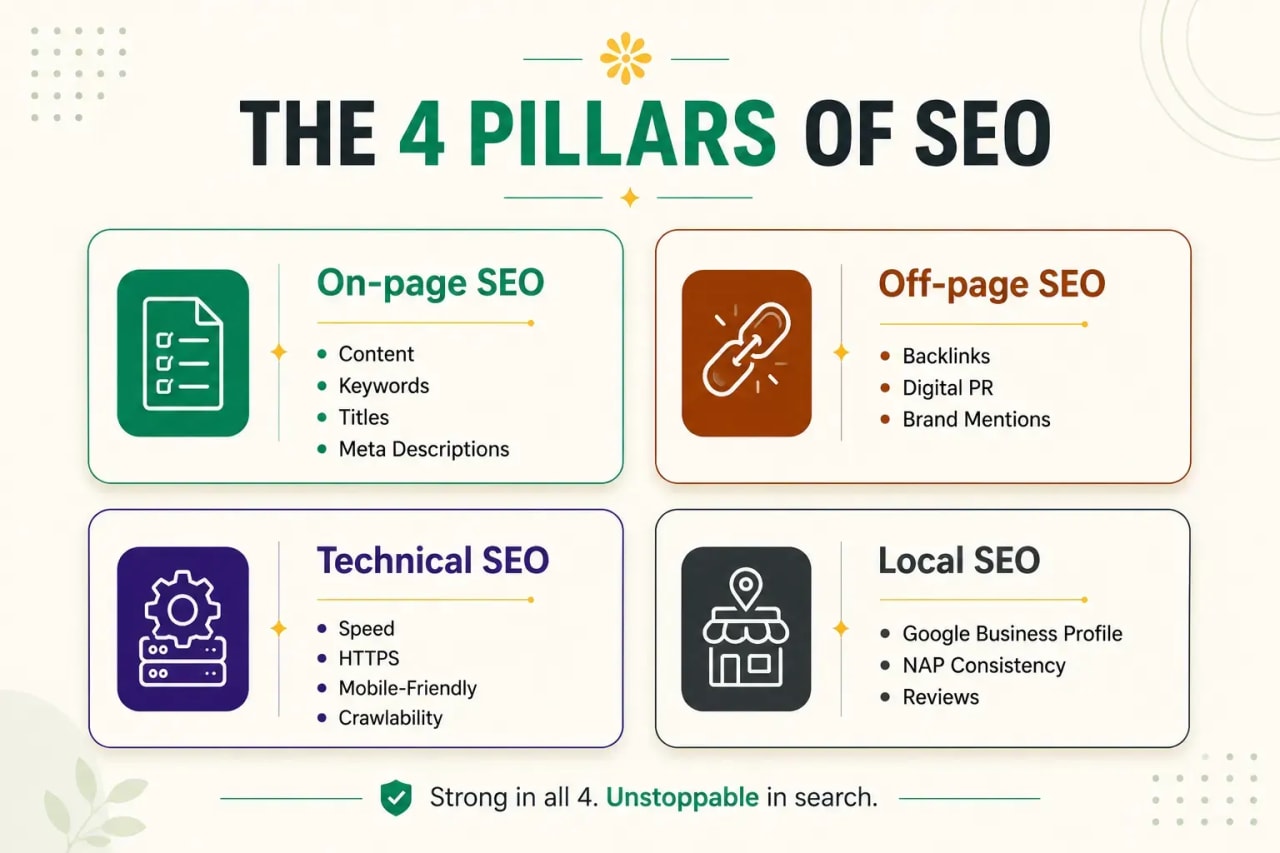
SEO is not one task. It is four connected types of work, and weak performance usually traces back to one of them being ignored. Here is what each one actually does, and what we fix first when a new client hands us their site.
1. On-Page SEO
On-page SEO is everything you control on the page itself. This is where most ranking is won or lost, because it tells both readers and search engines exactly what your page delivers. We treat it as the first fix because it is fully in your hands and pays off fastest.
Content quality: Write pages that answer the searcher's question better and more directly than anyone else ranking for it.
Keyword placement: Use your target term naturally in the title, the opening, and a subheading, without ever forcing it.
Title tags and meta descriptions: Craft a clear, specific title and a summary that earns the click in the results page.
2. Off-Page SEO
Off-page SEO is the trust you build beyond your own website. Search engines treat links and mentions from other reputable sites as votes of confidence. The more credible the source, the more that vote counts toward your authority.
Backlinks: Earn links from respected websites in your industry through genuinely useful content and relationships.
Digital PR: Get your business featured in local publications, directories, and industry roundups.
Brand mentions and social signals: Build a presence that gets your name talked about, which reinforces credibility over time.
3. Technical SEO
Technical SEO is the part nobody sees. If search engines cannot crawl, load, or read your site properly, even your best content stays invisible. This is the work that happens behind the scenes, and it is the one most agencies quietly skip.
Page speed: Make pages load fast, because slow sites lose both rankings and customers.
HTTPS and mobile-friendliness: Secure your site and make sure it works flawlessly on a phone, where most of your traffic comes from.
Crawlability: Use clean site structure, sitemaps, and clear navigation so search engines can find every page that matters.
4. Local SEO
Local SEO is how you win customers in your own city. For a business in Ranchi, Patna, or Indore, this is often the highest-return work we do, because it puts you in front of people ready to walk in or call today. The map pack at the top of local searches is prime real estate, and it is winnable.
Google Business Profile: Claim, complete, and actively maintain your profile, because it is the fastest local win we see.
NAP consistency: Keep your name, address, and phone number identical across every directory and listing.
Reviews: Earn genuine customer reviews and respond to them, since both trust and rankings depend on it.
How Search Engines Actually Work: Crawling, Indexing, and Ranking
To rank well for SEO in digital marketing, you need to understand the pipeline every page passes through. As Google's own search documentation explains it, search engines work in three sequential stages: Crawling, then Indexing, then Ranking. A page that fails at any stage never reaches the next one, which means un-crawled or un-indexed content can never rank, no matter how good it is.
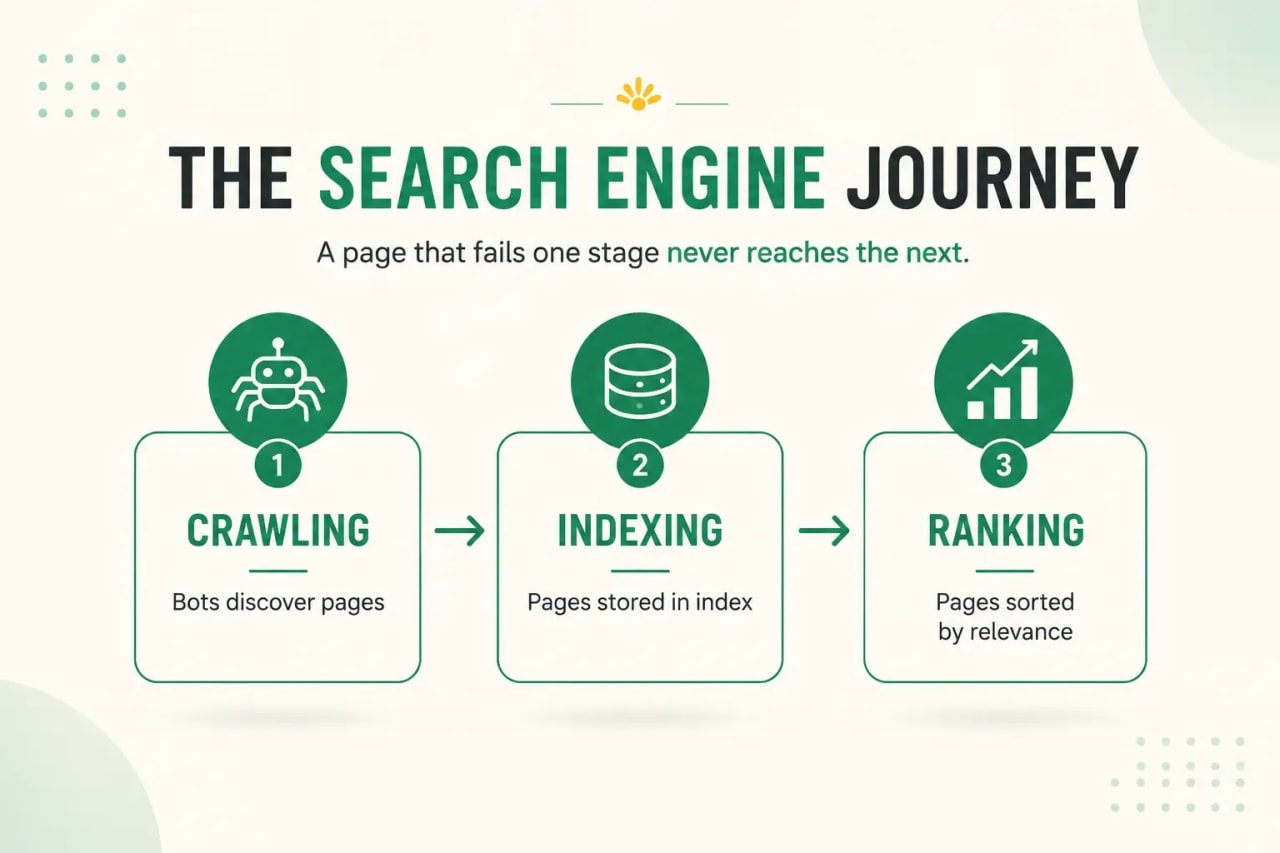
1. Crawling - The Discovery Phase
Crawling is how search engines find your pages. They send out automated bots, often called spiders or crawlers, that move across the web discovering new and updated content. If a bot cannot reach a page, that page effectively does not exist to Google.
Bots follow links from pages they already know to discover new ones, which is why internal linking matters.
Pages blocked by your robots file or buried with no links pointing to them often go undiscovered.
A clean sitemap submitted through Google Search Console helps bots find your important pages faster.
2. Indexing - The Storage Phase
Once a page is crawled, the search engine reads it and decides whether to store it in its index, a massive database of every page worth showing. If your page is not indexed, it cannot appear in results.
The indexer analyzes your text, headings, and tags to understand what the page is about.
Thin, duplicate, or low-value pages get filtered out and kept out of the index entirely.
Many modern sites rely on JavaScript, so bots run a second rendering pass to read content that loads dynamically. If that fails, your content may never get stored.
3. Ranking - The Evaluation Phase
Ranking is where the index gets sorted for every search. The engine weighs hundreds of signals to decide which stored pages best answer the query, then orders them. This is the stage everyone obsesses over, but it only works once crawling and indexing are clean.
Relevance and content quality: Does the page genuinely answer the search better than competitors?
E-E-A-T signals: Google's own quality rater framework of experience, expertise, authoritativeness, and trust shapes how human evaluators judge content quality, and that feedback trains the systems that decide how much to trust your page.
Core Web Vitals and backlinks: Page speed, stability, and the quantity and quality of links all feed the final order.
Why SEO Matters in Digital Marketing
The relationship between SEO and digital marketing matters because SEO is the only channel that keeps working after you stop paying for it. Paid ads stop the moment your budget runs out. A page that ranks today is still bringing in customers next year, with no extra spend. That is why we treat SEO as something you own, not something you rent.
Cost-effective, compounding growth: Once a page ranks, it brings in traffic without per-click costs, and that traffic tends to grow as your authority builds.
High-intent traffic and better conversion: People who search for a solution are ready to act, so they convert into inquiries and customers at far higher rates than ad audiences interrupted mid-scroll.
Builds brand trust and credibility: Ranking near the top signals to customers that you are an established, trustworthy name in your field.
Improves user experience: The same work that helps you rank, faster pages and clearer structure, also keeps visitors on your site longer and moves them toward action.
Adapts visibility across new platforms: Strong SEO now feeds visibility in AI search results, on YouTube, and across social platforms where people increasingly look for answers.
SEO and AI Overviews: Why Organic Visibility Still Matters
AI Overviews changed search, but they did not kill SEO in digital marketing. They made clear, well-organized content matter more than it used to. Pew Research Center tracked real browsing data and found people click through to a website less than half as often when an AI summary appears at the top of the page. To get cited inside that summary instead of buried beneath it, your content has to be structured so an AI can extract and quote it cleanly. Here is what we focus on to stay visible in this new landscape.
1. Structure Content for AI Extraction
AI engines pull answers in self-contained chunks, so your content needs to give them clean blocks to lift. The clearer your structure, the more likely you are to be quoted.
Lead with the answer in the first sentence of a section, then explain underneath.
Write subheadings as the real questions people ask, so they match how searches are phrased.
Use tight bullet points and short paragraphs, since AI models favor and often reuse well-formatted text.
2. Build Topical Authority
AI search rewards sites that cover a subject thoroughly, not those with one stray post. When you own a topic in depth, you become a source these systems trust to summarize.
Publish a connected set of pages around your core service rather than scattered, unrelated articles.
Link related pages together so the relationships between your topics are obvious.
Keep your best content current, because outdated pages quietly lose trust over time.
3. Earn Citations and Mentions
AI Overviews lean on sources with real credibility behind them. The same trust signals that help you rank also decide whether you get cited in an AI answer.
Earn mentions and links from respected sites and local publications in your space.
Show genuine experience in your content, with real examples and results rather than generic advice.
Keep your business details and author information consistent and verifiable across the web.
SEO vs. SEM vs. PPC: What's the Difference?
These three terms get used interchangeably, but they are not the same thing. Knowing the difference helps you decide where to put your money.
Strategy | Full Form | Payment Model | Speed of Results |
|---|---|---|---|
SEO | Search Engine Optimization | Free (organic) | Slow (months) |
PPC | Pay-Per-Click | Paid | Instant |
SEM | Search Engine Marketing | Combines both | Mixed |
In practice, the smartest approach to SEO in digital marketing blends both organic and paid together. We often run PPC to capture demand immediately while SEO builds underneath, so a client sees leads now and pays less for them later as organic rankings take over. In SEO and digital marketing, SEM is simply the umbrella that holds both.
How to Build an SEO Strategy (Step-by-Step)
A real SEO strategy in digital marketing is not a pile of tactics. It is an order of operations. If you build links before your pages are worth ranking, you are paying to promote a leaky bucket. Here is the six-step roadmap we follow when we build an SEO strategy from scratch.
Step 1: Define Your Business Goals and KPIs
We never start with keywords. We start with what success actually looks like for your business, then work backward to the search metrics that lead there.
Set the real goal first: more inquiries, more bookings, or more revenue.
Choose tracking metrics like organic conversions and qualified leads, not just traffic.
Tie ranking targets to pages that drive money, not vanity terms.
Step 2: Audit Your Existing Website
Before changing anything, we find out where you stand. An honest audit shows what is already working and what is quietly holding you back.
Check current rankings and which pages bring in any organic traffic today.
Run a technical health check for speed, mobile issues, and crawl errors.
Spot the content gaps where competitors rank and you do not.
Step 3: Research Keywords and Search Intent
Ranking for the wrong terms wastes months. We map what your customers actually type, and what they expect to find when they type it.
Find the terms your buyers use, including the smaller, specific ones with real intent.
Match each term to its intent: learning, comparing, or ready to buy.
Prioritize the searches most likely to turn into customers.
Step 4: Optimize On-Page and Technical SEO
Now the building begins. We make each target page genuinely useful and make sure search engines can read it without friction.
Write and optimize page content around its keyword and the searcher's real question.
Fix title tags, meta descriptions, and heading structure on every key page.
Resolve speed, mobile, and crawlability issues so nothing blocks your rankings.
Step 5: Build Authority Through Backlinks and Local/AI Search
Strong pages still need credibility behind them. This step builds the trust signals that push you past competitors and into AI answers.
Earn quality backlinks through useful content and local relationships.
Optimize your Google Business Profile and local listings for map visibility.
Structure content so it gets pulled into AI Overviews and answer engines.
Step 6: Track, Measure, and Iterate
SEO is never finished. We watch the numbers, learn what is working, and double down, while quietly cutting what is not.
Monitor performance in Google Search Console and Google Analytics.
Review results against the KPIs you set in Step 1.
Adjust the strategy based on real data, not guesses.
How to Measure SEO Success: Key Metrics That Matter
Measuring the success of SEO and digital marketing by rankings alone is outdated. A number-one ranking that brings no customers is worth nothing. We group the metrics that matter into four layers, starting with the only one that pays the bills.
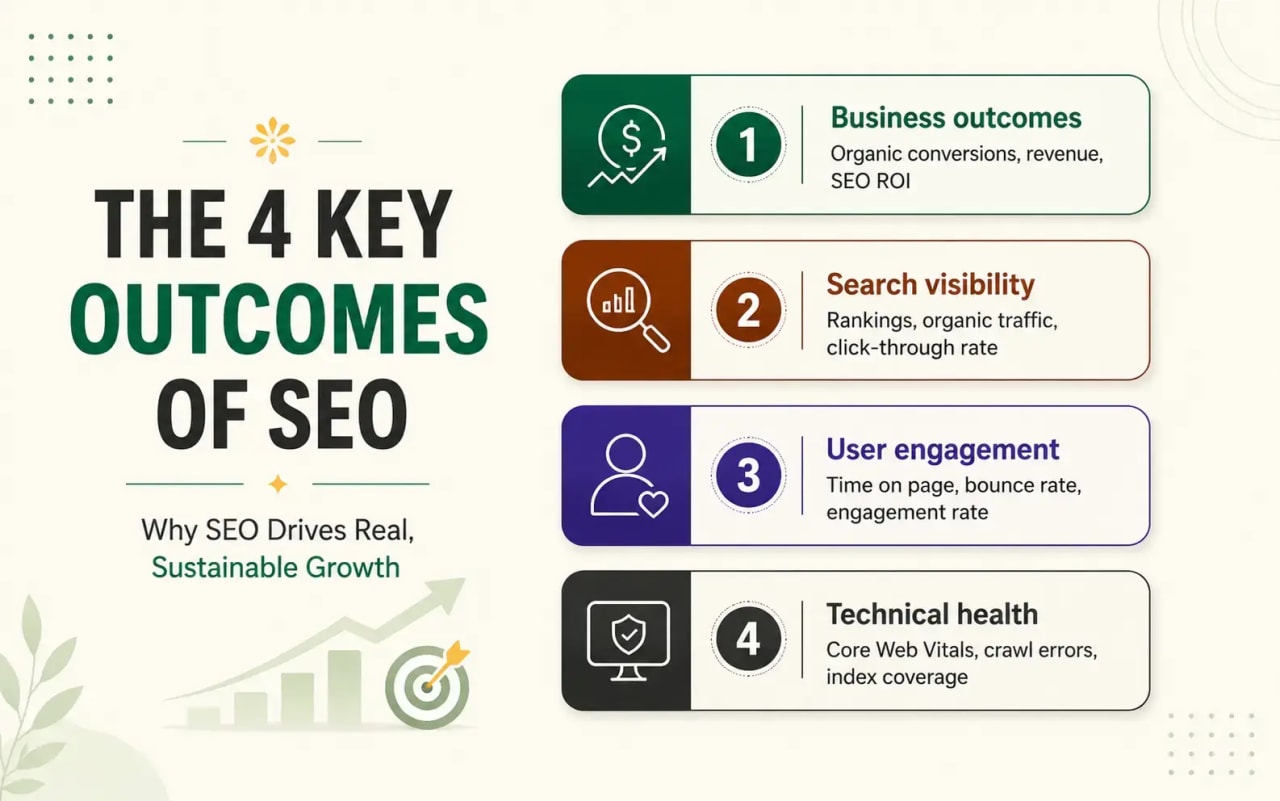
1. Business Outcomes
These prove the return on your investment. They are the metrics we report first, because they are the ones you actually care about.
Organic conversions: Inquiries, calls, and form submissions from organic search.
Organic revenue: The money traceable directly to organic visitors.
SEO ROI: Revenue earned against what you spent on tools and people.
2. Search Visibility
These show how often and how high you appear. They are early indicators that your work is gaining ground.
Keyword rankings: Where your pages sit for the terms that matter.
Organic traffic: The volume of visitors arriving from unpaid search.
Click-through rate: The share of searchers who actually click your listing.
3. User Engagement
These reveal what happens after the click. Strong engagement tells Google your page deserves its position.
Time on page: How long visitors stay and read.
Bounce rate: How many leave without taking any further action.
Engagement rate: How actively people interact with your content.
4. Technical Health
These are the foundation metrics. Let them slip and everything above suffers.
Core Web Vitals: Loading speed, interactivity, and visual stability.
Crawl errors: Pages search engines cannot reach or read.
Index coverage: How many of your important pages are actually indexed.
Essential SEO Tools to Get Started
You do not need expensive software to start with SEO in digital marketing. The most reliable data comes free from Google itself, and you can add paid tools later as you scale.
Free foundation:
Google Search Console: Monitors how Google indexes your site and which queries bring traffic.
Google Analytics: Tracks what visitors do once they land and which pages convert.
PageSpeed Insights: Flags speed and Core Web Vitals issues to fix.
Paid and pro tools:
Semrush: Deep keyword research, competitor tracking, and ranking reports.
Ahrefs: Strong for backlink analysis and finding link opportunities.
Screaming Frog: Crawls your whole site to surface technical issues at scale.
Common SEO Mistakes to Avoid
We see the same SEO mistakes that should be avoided sink businesses over and over. Usually it is not a lack of effort. It is effort pointed at the wrong things. Here are the ones that cost the most:
Content and Keyword Missteps
Keyword stuffing: Forcing terms unnaturally, which hurts readability and triggers penalties.
Ignoring search intent: Writing content that does not match what the searcher actually wants.
Publishing thin content: Putting out short, surface-level pages that signal low value to Google.
Technical Weaknesses
Slow page speed: Heavy pages and oversized images that drive visitors and rankings away.
Poor mobile experience: A site that frustrates phone users, who are most of your traffic.
Broken links and crawl errors: Dead ends that waste crawl budget and weaken trust.
Strategic Oversights
No measurement framework: Doing the work without tracking whether it produces customers.
Ignoring local and AI search: Missing the map pack and AI Overviews where local demand now lives.
How Artha Social Can Help You Get These Results
Everything above is doable on your own. The catch is doing it consistently, month after month, while you are also running a business. That part almost never happens. The audits get delayed, the content slows down, and the technical fixes sit untouched. That is the gap we close.
We are Artha Social, a digital marketing agency that connects SEO and digital marketing as one growth system, built for serious businesses in Tier-1, Tier-2 and Tier-3 Indian cities. We handle all four types of SEO as one connected system: optimizing your pages, fixing the technical foundation, building real authority, and owning local search in your city. We report on inquiries and revenue, not impressions, because those are the numbers that grow a business.
If you are ready to turn organic search into a steady source of customers instead of a line item you keep paying for, check our SEO services. We will show you exactly where the opportunity is.
Frequently Asked Questions
What is SEO and its role in digital marketing?
SEO (Search Engine Optimization) is the strategic process of optimizing a website to increase its visibility and rank higher on search engine results pages like Google, Bing, and Yahoo. Unlike paid advertising, SEO focuses entirely on earning organic, non-paid traffic by aligning a website's content and technical setup with what search engine algorithms and users are looking for.
What are the 4 pillars of SEO?
The four pillars of SEO are Technical SEO, On-Page SEO, Content, and Off-Page SEO. Together, they form a comprehensive framework that helps search engine algorithms find, understand, and trust a website while providing a high-quality experience for users.
Can ChatGPT do SEO?
Yes, ChatGPT can assist with SEO, but it cannot do SEO entirely on its own. Think of it as a capable assistant that speeds up content creation, formatting, and ideation. However, it lacks live search traffic data, cannot crawl backlink profiles, and cannot perform direct technical site audits which a real SEO strategy requires.
Will AI replace SEO?
No, AI will not replace SEO, but it is fundamentally changing how it works. As long as people search for information online, businesses will need to optimize their content to be found. Traditional SEO focused purely on ranking "10 blue links" is shifting toward optimizing for AI-driven ecosystems, but the need for SEO itself is not going away.
What is the latest SEO algorithm?
There is no single "latest" SEO algorithm. Google uses a complex, interconnected system of algorithms updated thousands of times per year. The most significant current shift is Google's reliance on Generative AI models built on Gemini, which powers AI Overviews and places heavy emphasis on Entity SEO, semantic depth, E-E-A-T signals, user engagement data, and Core Web Vitals rather than isolated keyword matching.
About the Author
Anand Pandey
Founder, Artha SocialBBA, Amity University · Ex-NoBroker · 4+ years in SEO
Anand Pandey is the founder of Artha Social and an SEO professional with 4+ years of experience building search strategies across multiple industries. Before founding Artha Social, he managed end-to-end SEO campaigns at NoBroker, one of India's leading real estate platforms. He holds a BBA from Amity University.
Newsletter
Get the SEO playbooks your competitors are searching for.
Weekly marketing techniques, proven strategies, and growth insights — no fluff.